Legal Front Door
The single, structured entry point for all legal requests in your organization — with AI-powered triage, automated routing, and real-time visibility for in-house legal teams.
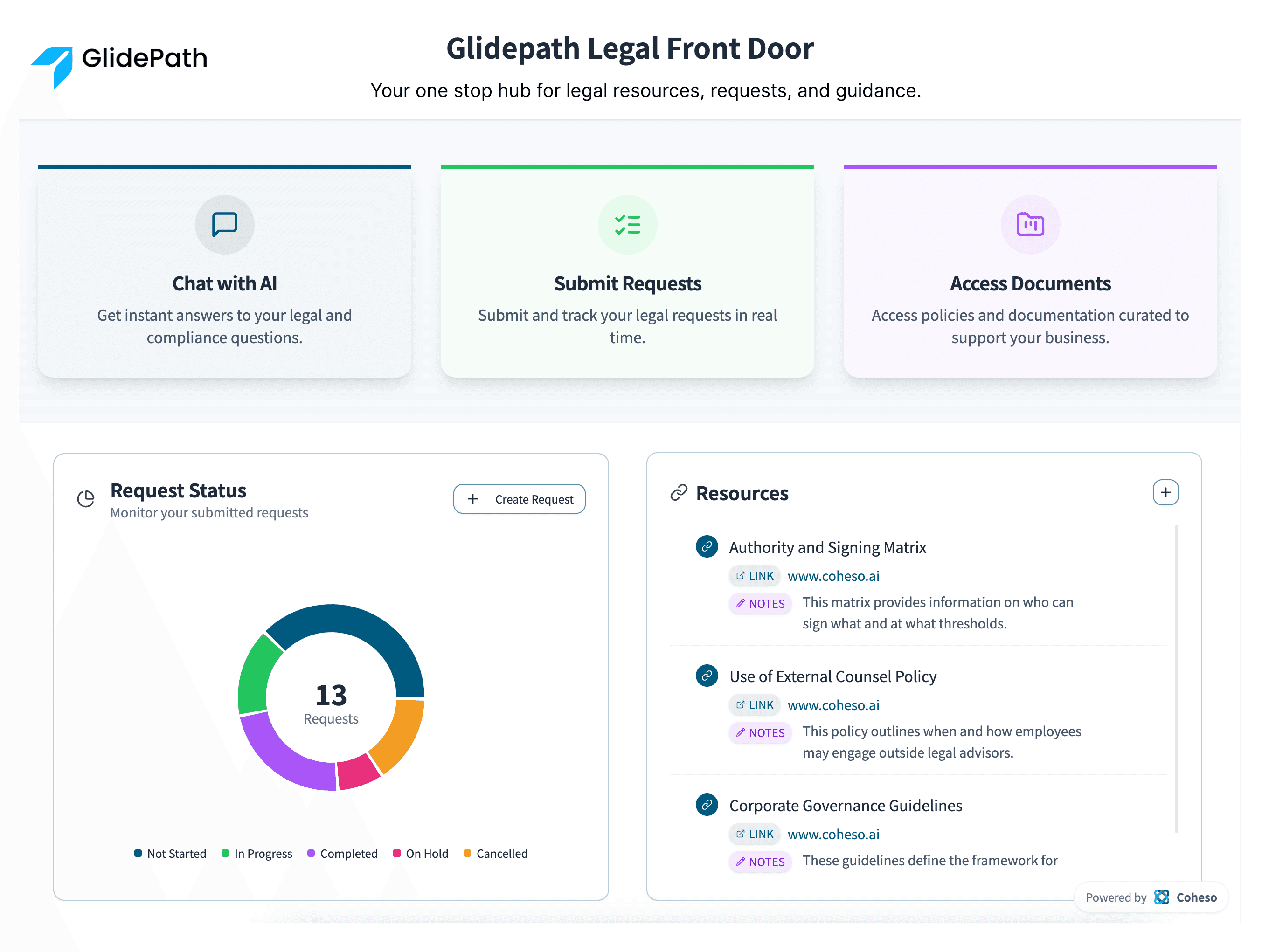
What Is a Legal Front Door?
A legal front door is a single, structured entry point for all legal requests within an organization. It is a system that captures incoming work from any channel, routes it to the right legal team member, and creates the consistent data foundation that makes AI-powered automation possible.
For in-house legal teams, the legal front door replaces the patchwork of email threads, Slack messages, and ad hoc requests that define most departments today. Instead of legal managing multiple inboxes and chasing context, every request arrives structured, categorized, and ready to act on. Routine questions are answered instantly by AI. Complex matters reach the right in-house counsel with full context attached.
Unlike a shared inbox or generic project management tools, a legal front door captures requests from the channels your business already uses, structures every request the way legal teams work, and automates legal work from request to resolution.
Shared inbox
- Unstructured requests that don't contribute to data-driven decision making
- Legal teams manually triage, tag, and assign every request
- Status is buried in threads without visibility or prioritization
Collaborative work management
- Built for general projects, not legal workflows
- Requires manual setup for every request type with no legal-specific defaults
- Tracks task progress but not request origin, type, volume, or resolution time
Legal front door
- Single, structured entry point purpose-built for legal work
- Requests come from existing channels with smart defaults
- AI routes and labels requests automatically with legal-specific defaults
For a deeper look at how the legal front door concept applies to legal operations, read our full guide
Why In-House Teams Need a Legal Front Door
Business moves faster than legal can respond, and the gap is widening. In-house legal teams are expected to support growing demand with the same headcount, while AI accelerates the pace of every other function. The problem is not capability. It is infrastructure.
Requests arrive through too many channels
Email. Slack. Teams. A colleague stopping by your desk. Each channel creates a parallel queue with no shared visibility and no consistent structure. In-house legal teams spend significant time just monitoring inboxes and following up for missing information. A single intake point eliminates the noise and gives business users a reliable way to get answers faster.
Legal teams orchestrate instead of advise
Without a structured intake process, legal teams manually triage every request, chase context, assign tasks, and follow up on status. Capturing full context at the beginning, routing work automatically, and surfacing a first response saves time and frees up the legal department to work on priority items.
No visibility into workload or demand
Without a central system, there is no reliable data on how many requests legal receives, what types they are, how long they take to resolve, or which business units drive the most demand. Legal cannot make an evidence-based case for resources, cannot identify automation opportunities, and cannot demonstrate value to the business without this foundation.
How a Legal Front Door Works
Every request follows a consistent lifecycle from submission to resolution, regardless of where it originated or how complex it is. Here is how it works in practice:
- 1
Business user submits a request
From email, Slack, Teams, or a branded legal portal — without changing the tools they already use. The system meets them where they work. Flexible intake options capture general requests or guide users through a structured form when more detail is needed upfront.
- 2
AI categorizes and routes
The moment a request arrives, AI generates a title, assigns a category, and routes the request to the right lawyer or queue. For routine questions, AI can respond instantly using knowledge sources the legal team has approved and configured.
- 3
Legal acts within a shared workspace
The in-house legal team reviews, responds, and collaborates within a single workspace. Both sides can see status in real time, eliminating follow-up emails. For structured requests, AI provides a first-pass review — flagging key terms, checking against playbooks, and summarizing findings before the lawyer opens the file — all within the guardrails each organization sets.
- 4
Every request is tracked and reported
Outcomes are logged automatically, building an institutional knowledge base over time. Analytics surface workload trends, average turnaround times, peak demand periods, and recurring request types — giving legal the data to demonstrate value and plan resources proactively.
Coheso's Legal Front Door
Coheso brings this architecture to life through four core capabilities — each designed to be configured by legal without IT involvement and live within days, not months.
Instant answers with legal oversight
Business users get immediate responses to routine questions through an AI assistant that legal controls.
- Embedded guidance gives legal control over AI responses
- Linked references support and verify AI responses
- Custom validation rules escalate requests for legal review

Hello Emily! How can I assist you today?
Is it okay if I give my client a gift card to thank them for taking a meeting?

| Rule Name | Rule Type | Document Triggers |
|---|---|---|
| Require Validation for Anti-Bribery Questions | Validation | default_documents/Slipstream Anti-... |
Thank you for your question. I have created a draft response, but your organization requires that it first be validated by the legal department. Please click this link to confirm that I may raise the request to them.
Context-rich requests from the start
Custom intake forms capture the full context legal needs up front. AI prefills forms from context shared in Slack, Teams, and other integrated sources.
- Capture full context with custom forms
- Business inputs enable AI-powered labeling, routing, and first-pass review
- Trigger downstream workflows in CLMs and integrated platforms
Create New Request
Enter the details for your new request.
The date by which the request needs to be completed
Provide any relevant background on the deal
Enter Potential Deal Size
Keep legal and business aligned
Real-time notifications and shared context keep all stakeholders informed throughout the request lifecycle.
- Real-time notifications keep stakeholders informed
- Shared context supports cross-functional collaboration
- Request tracking gives business users visibility into status and outcomes
William Garcia assigned you to request: Review Redlined Employment Terms for New Hire
2026-06-24, 03:36 PM
Tim Wilson commented on Request - 'Website Using Our Advertising Language Query': One of our clients reached out because they saw th...
2026-06-24, 03:35 PM
New request created: Legal Protections for Medical Leave Inquiry
2026-06-10, 10:55 PM
New request created: NDA Review for London Client Opportunity
2026-06-10, 10:54 PM
Meet business users where they work
Business teams can submit requests directly from Slack, Teams, and email without leaving their preferred tools.
- Create tasks from Slack, Teams, and email
- Route off-channel requests back into a central workspace
- Runs behind your stack or serves as your central legal workspace
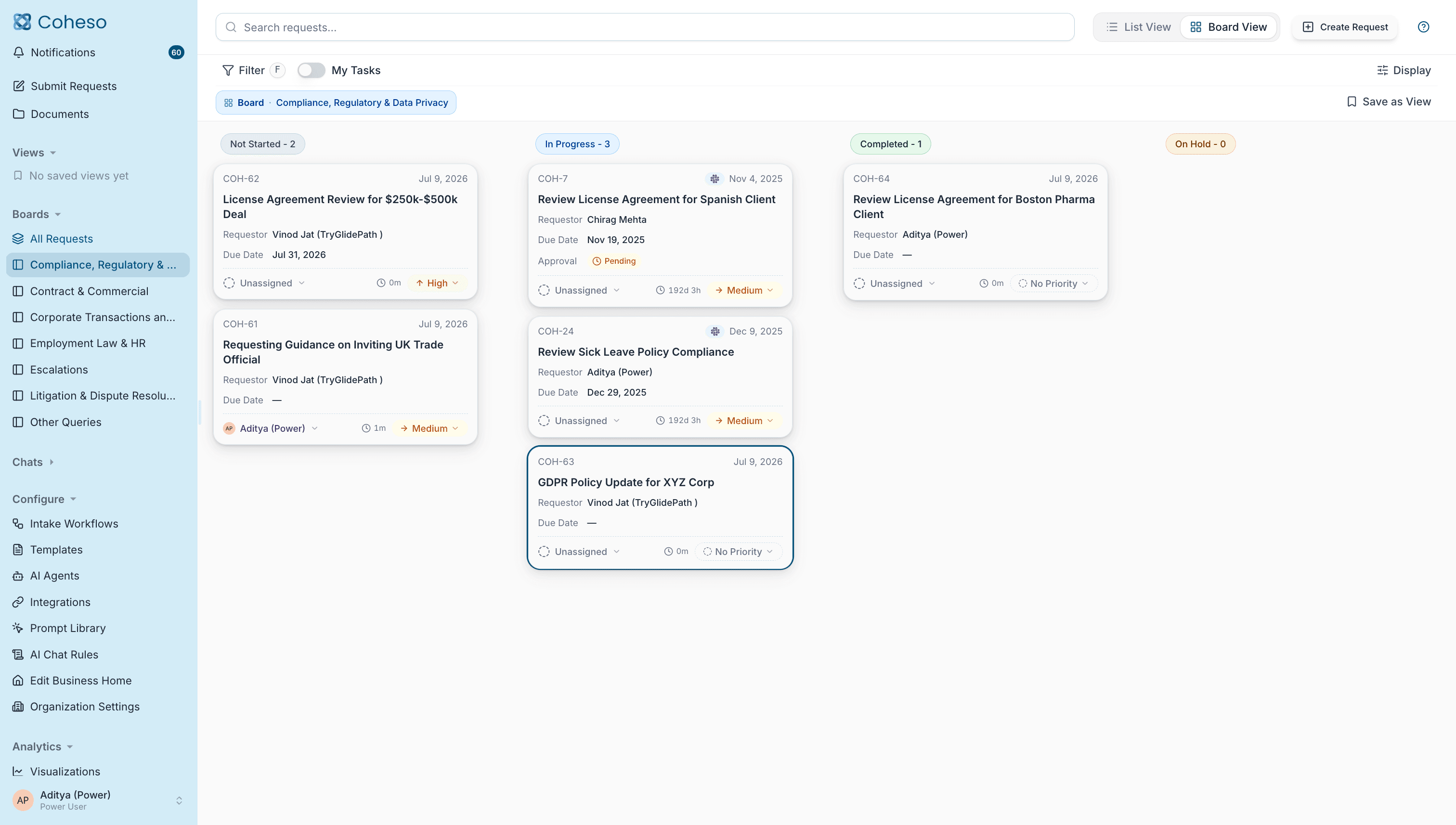
All requests across channels in list or kanban view


 COH-22
Create NDA for Acme Partnership
Not Started
 COH-1
COH-1NYC lease termination review
In ProgressCOH-10Review Vendor Contract Terms
Completed Mar 12
Create NDA for Acme Partnership

 Mar 29
NYC lease termination review
 Mar 7
Mar 7Review Vendor Contract Terms


Customize Flows
Integrate with enterprise and legal tech tools you already use. Coheso unifies legal work in one place, with integrations that consolidate requests and trigger action across your stack.
 Gmail
Gmail Outlook
 Slack
Slack TeamsGmailOutlookSlackTeamsGmailOutlookSlackTeams
 Google Drive
 SharePointGoogle DriveSharePointGoogle DriveSharePoint
What Changes When Legal Has a Front Door
The impact is felt on both sides of the relationship.
For the legal team
- One system of record — every request is visible, tracked, and searchable from day one
- Full context at intake — in-house legal teams start substantive work immediately, without chasing background
- Workload data — analytics to demonstrate demand, justify resources, and identify automation opportunities
For business stakeholders
- One clear channel — no more uncertainty about how to reach the legal team or which inbox to use
- Real-time status — visibility into where every request stands, without sending a follow-up email
- Faster answers — self-service for routine questions, expert escalation for anything more complex
See It in Practice: M42's Legal Team
M42 is a global health enterprise operating across 26 countries, supported by a 10-person in-house legal team managing multi-jurisdictional complexity at scale. With Coheso's legal front door, their team replaced fragmented request management with a structured, AI-powered intake system — without disrupting the tools the business already used.
Read the full M42 case study“Coheso has made our value clear. By making our process transparent and easy to follow, we help the business understand what we deliver and why it matters. When routine tasks are handled quickly and visibly, it creates trust and gives us space to do the high-level work that requires thought and care.”
What to Look for in a Legal Front Door Solution
The legal front door will become the day-to-day operating system of your legal department. Choosing the right platform matters as much as deciding to implement one. These criteria separate solutions that drive transformation from those that create new overhead.
Native integrations with tools your teams already use
The fastest path to adoption is meeting employees where they work. A legal front door that requires a new URL or separate login will see low uptake. Prioritise platforms with native Slack, Teams, Outlook, and Gmail integrations.
Enterprise-grade security built in, not bolted on
The legal front door handles sensitive requests, confidential documents, and privileged communications. SOC 2 Type II certification, GDPR compliance, and full audit trails are non-negotiable. Ask vendors whether security features are included in the base product or available only on enterprise tiers.
Time to value in days, not months
A legal front door should not require a multi-month implementation project. The right platform connects to your existing tools, is configurable through a UI, and has your legal team live in the first week. If a vendor leads with a professional services engagement before you can use the product, treat that as a red flag.
Frequently Asked Questions
What is a legal front door?
A legal front door is a single, structured entry point for all legal requests within an organisation. It directs requests from any channel — email, Slack, Teams, or a branded legal portal — into a shared workspace where work is captured, triaged, routed, and tracked. Unlike a shared inbox, a legal front door creates structured data that enables AI-powered automation at scale.
What is the difference between a legal front door and a shared inbox?
A shared inbox consolidates messages but creates no structure. A legal front door captures the who, what, and when of every request at intake and enables automatic routing, AI-powered first-pass review, SLA tracking, and analytics. The structured data it creates is what makes automation possible and gives legal the visibility to plan and demonstrate value.
What channels does a legal front door support?
Modern legal front doors integrate with email, collaboration platforms, document repositories, and CLMs. Requests from any channel flow into a single legal queue so nothing is missed regardless of how the business submitted it.
How long does it take to implement a legal front door?
With the right platform, a legal team can be live within a month. The core requirement is connecting your existing tools and configuring intake forms and routing rules. No custom development or lengthy IT projects are required. Coheso customers typically go live in under a month.
What is the return on investment from a legal front door?
ROI comes from three sources: operational efficiency (faster turnaround, fewer follow-ups, less time managing chaos), risk reduction (audit trails, consistent process, compliance logs), and strategic visibility (analytics that surface demand patterns and support resource planning). Every request becomes trackable and reportable from day one. Use Coheso's ROI calculator to model the impact for your team.
How does AI work inside a legal front door?
AI takes the work that happens before the legal team gets involved. When a request arrives, AI routes it to the right team member, labels it by priority and type, and begins a first-pass review. Routine questions are answered from approved playbooks, checking contracts against templates, and flagging risks. The legal team controls which AI capabilities are active and what guardrails apply.
See Coheso's Legal Front Door in Action
Join in-house legal teams who have replaced scattered request management with a structured, AI-powered legal front door. Request a personalised demo today.