Coheso CEO Ned Gannon Featured on Ari Kaplan's Reinventing Professionals Podcast
Dec 1, 2025

Written by
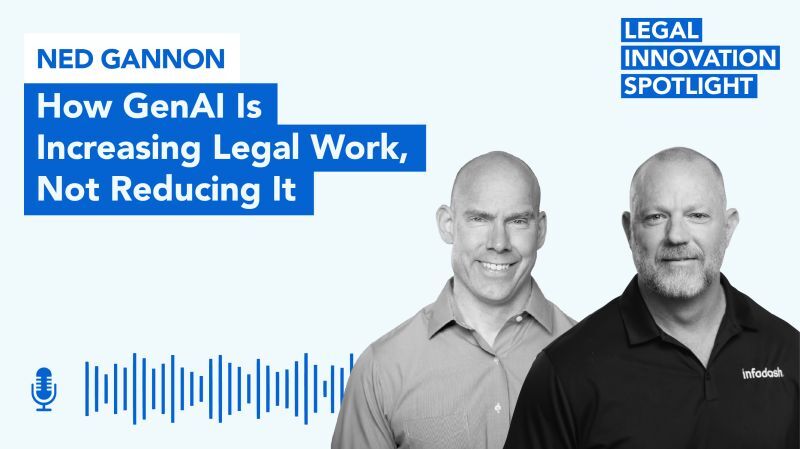
Coheso CEO Ned Gannon recently joined Ari Kaplan on the Reinventing Professionals Podcast to discuss the evolution of legal operations and how AI is enabling in-house legal teams to operate more strategically.
Building an AI-Native Legal Front Door
Ned shared how Coheso serves as a primary, AI-native interface between legal teams and the business—capturing, orchestrating, and automating legal work in one shared, actionable view with analytics. Lawyers retain full control, while AI handles the first pass.
The platform meets business users where they are, accepting requests through email, Teams, Slack, or a business user facing homepage, which reduces change management friction and accelerates time to value.
For questions that can be answered based on company policies, contracts, or documentation, the system generates responses with linked evidence and routes them either directly to business users or to legal for review. More complex requests are prioritized, delegated, and tracked within Coheso's work management module.
Addressing Barriers to Adoption
When asked about the biggest obstacles to AI adoption within in-house legal teams, Ned identified three core challenges.
Clarity is the first hurdle. Many legal teams still struggle to identify where AI can drive tangible value. The promise of AI is abstract until it's connected to real workflows and measurable outcomes.
Confidence is equally critical. Legal departments are inherently risk-conscious. They want assurance that AI tools are secure, compliant, and accurate—and that their data won't be exposed or misused. Without that trust, adoption stalls.
Finally, there's change management. Even strong technology fails to gain traction if it sits outside existing workflows or if incentives are misaligned. The tools that succeed are the ones that integrate into the daily flow of work.
Within the Coheso platform, each of these barriers has been directly addressed through transparency and integration into existing systems.
Legal as a Growth Enabler
The conversation also explored how legal teams can demonstrate strategic value beyond risk management. By centralizing intake and automating triage, Coheso helps legal teams respond faster, accelerate contract cycles, and remove friction from revenue-generating work.
The platform gives GCs visibility into matter volume, response times, and value created across functions. These metrics allow them to quantify legal's impact on business velocity and demonstrate, with data, how legal directly contributes to organizational growth and performance.
Lessons from Scaling Legal Tech
Drawing on his experience founding and exiting eBrevia, Ned shared insights for legal tech founders. While the market landscape has changed significantly, certain lessons remain relevant.
Legal tech success isn’t just about building powerful technology—it’s about aligning deeply with how legal teams create business value. Adoption and measurable impact remain the true differentiators. Legal departments are under pressure to move faster, reduce friction for the business, and demonstrate their contribution to revenue generation and risk reduction.
Designing for integration and workflow is critical. The most successful tools become embedded in the daily collaboration between legal, sales, procurement, and compliance—rather than functioning as standalone systems that require constant context-switching.
Non-Negotiables for Responsible AI
Trust was a recurring theme throughout the conversation, particularly when it comes to responsible AI in the legal domain. Ned outlined three non-negotiables:
First, transparency. Every AI-driven recommendation should be explainable, with clear visibility into the data sources, reasoning steps, and limitations.
Second, auditability. Organizations need an immutable record of AI inputs and outputs to verify consistency, ensure accountability, and satisfy compliance or discovery requirements. This creates a foundation of trust that the system is behaving as expected over time.
Third, human oversight. AI should augment judgment, not replace it. Clear guardrails should define when human review is required, and the system should make escalation seamless when it's needed.
These principles are foundational to how Coheso is built, creating confidence that AI is not only powerful but responsibly deployed in a trust-critical domain.
The Future of Legal Operations
Looking ahead, Ned sees legal operations and AI tools converging toward a truly intelligent operating layer for the enterprise.
The early phase of legal AI focused on automating discrete tasks like drafting, summarizing, or searching. What's next is orchestration: AI that can understand context, manage workflows across departments, and proactively surface insights that drive business outcomes.
For legal operations, this means a shift from reactive service management to strategic enablement. Legal teams will increasingly measure success not only by speed or cost savings, but by the value they unlock that wasn’t possible before—faster revenue cycles, reduced risk exposure, and improved stakeholder experience.
AI-native systems like Coheso will act as the connective tissue—integrating intake, triage, matter management, and compliance in ways that make legal data actionable at scale. The result is a legal function that doesn't just keep pace with the business, but actively propels it forward.
Listen to the full conversation on Reinventing Professionals for insights on responsible AI and how the role of in-house legal teams is evolving.