
Coheso Team
Coheso Team
Most AI tools require you to bring work to them. You paste documents into chat interfaces, prompt for analysis, then manually transfer outputs back to your systems. This creates friction at every step.
Coheso routes all legal work through a structured front door, giving AI the foundation it needs to act automatically. Agentic Workflows build on this foundation, activating the moment work enters the system to generate first-pass reviews based on business inputs and grounded in legal resources and guidance. Attorneys maintain full oversight while AI accelerates every request.
This works because agents are enabled to act at the intersection of business and legal. Business users submit requests with full context about what they're trying to accomplish. Attorneys pre-configure agents with playbooks, risk thresholds, and evaluation criteria. When preconfigured agents are pointed at incoming business requests, they become collaborative engines acting on legal and business inputs simultaneously.
Agents Activate When Work Arrives
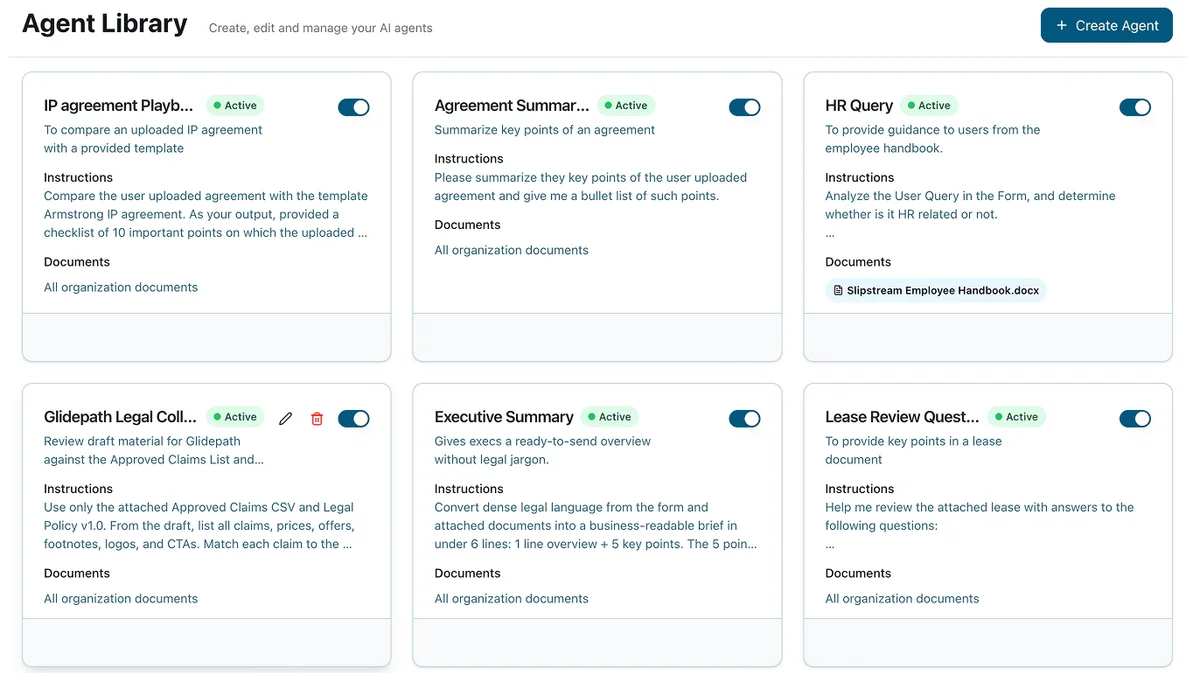
The Agent Library is where your legal team builds and manages agents tailored to different types of work. Each agent includes:
- Custom instructions that define what the agent should do and how it should approach the work, including risk thresholds and evaluation criteria.
- Supporting documentation like playbooks, templates, and examples that guide the agent's analysis and set expectations for outputs.
- Access to enterprise legal knowledge, including all the policies, precedents, and guidance your team has built over time.
Agents attach to specific intake workflows in your work management platform. When a business user submits a request through that form, the assigned agents trigger automatically. Within minutes, they generate first-pass reviews that appear as internal comments on the request, ready for your team to review and refine.
Multiple agents can work on a single incoming request from different perspectives. One agent might assess commercial risk while another checks regulatory compliance. A third might compare terms against your standard playbook. Each brings its own instructions and documentation to the task, and all outputs appear together on the request for attorney review.
Multi-Step Reasoning Through the Planning Layer
Legal work rarely reduces to simple lookups. It requires breaking down complex instructions and questions, consulting multiple sources, checking for gaps, and synthesizing coherent answers. This level of complexity demands more than retrieval-augmented generation or single-prompt responses.
Behind the scenes, each agent is powered by an agentic planning layer that operates like a project manager for complex legal questions. It breaks queries into focused steps and routes each step to the appropriate AI capability. The planning layer coordinates three specialized modules:
- Search specialist scans across all documents to answer specific questions, finding relevant passages and synthesizing responses from your entire repository.
- Analyzer module reviews each document systematically and aggregates results, working through complex sets of materials to build a complete picture.
- Deep-review engine examines agreements and policies to generate summaries, assess risks, and complete compliance checks against your standards.
The planning layer evaluates intermediate responses, identifies gaps, and loops back through search, analysis, or review as many times as needed. Only when the question is fully addressed does it synthesize a structured response grounded in your actual documents with full citations.
This architecture enables a true agentic experience where the system reasons through problems step by step, using specialized capabilities as needed.
Business Context Meets Legal Guidance
Agent effectiveness depends on context engineering as much as prompt quality. The goal is to bring business inputs and legal guidance together so AI can act on both.
Agentic Workflows operate with three layers of context simultaneously:
- Your document repository gives each agent access to your company's agreements, policies, playbooks, and precedents. This is your organization's specific guidance, the same documents that power AI responses to routine business inquiries through the legal front door.
- Business user inputs bring everything the requester entered on the intake workflow into the agent's context, including deal details, specific concerns, urgency flags, attachments. Each agent sees the full picture of what the business is trying to accomplish.
- Attorney pre-configuration provides the custom instructions, guidance, risk thresholds, and supporting documentation you've set up for each agent. Every agent knows what to look for and how your team evaluates it.
When an agent is activated by an incoming request, it synthesizes across all three layers. Agentic outputs reflect the specific situation analyzed against your playbooks, repository, business context, and standards. The result is analysis that reflects business and legal considerations.
Building on the Legal Front Door
Coheso's legal front door and work management platform provides legal and compliance teams with a universal gateway to capture, triage, and resolve all incoming questions and requests regardless of where they originate. Routine inquiries are answered automatically with AI responses grounded in company-specific documents and policies. More complex work is prioritized and routed to the legal team with full context. AI-response rules can be enabled to escalate certain inquiries to the legal team and further refine AI responses at the document level.
Agentic Workflows extend this foundation. Structured intake that captures business context now feeds directly into agent processing. Document repositories that power routine Q&A now inform sophisticated multi-step analysis. The work management system that tracks requests now displays agent-generated first-pass reviews alongside attorney work.
Integration Enables Automatic Action
Coheso integrates with communication channels where business already works, including email, Microsoft Teams, and Slack. Requests that originate from any of these channels flow into the same centralized work management system where agents process them.
Integrated agents turn these structured business inputs into real progress on legal work. Meanwhile, legal teams maintain oversight while giving the business a faster, more reliable path to resolution. The value comes from having both sophisticated AI and workflow automation work together in the same system:
- Speed improves because work advances before attorneys open the request.
- Consistency improves because the same guidance applies to every request of that type.
- Visibility improves because all work, AI-assisted and attorney-driven, lives in one shared view with analytics.
As agents apply legal knowledge at scale, business is able to move faster. The configure once, apply to all relevant requests approach creates significant leverage for legal teams.
Ready to see how this works with your team's specific workflows? Request a demo to explore how Agentic Workflows can integrate into your legal operations.