
Coheso Team
Coheso Team
Legal AI budgets are growing faster than many departments' ability to prove what they are getting in return.
In the 2026 Axiom In-House Legal AI Report, every surveyed legal team already using AI said it expects its AI budget to grow in the next cycle. None planned to cut. At the same time, only 17% of AI-using teams said they had established metrics and were tracking AI ROI regularly.
The measurement gap is also visible in Thomson Reuters' 2026 research, which found that only about one-quarter of legal departments are measuring the ROI of their AI tools. Among those that do, 80% track internal cost savings.
The challenge starts earlier than choosing the right formula for ROI.
You cannot measure what AI changed if you do not know what the department was handling before AI arrived.
That makes the baseline just as important as the AI.
What Does Legal AI ROI Actually Mean?
Measuring legal AI ROI means tracking what changed in the department's actual work after AI was introduced. That means looking beyond tool adoption or hours saved and asking what happened to the work itself: how much demand arrived, how quickly it moved, how much could be resolved without lawyer involvement, what it cost to handle, and whether quality and risk outcomes held.
Those measures turn AI ROI from a claim about productivity into a comparison of how the legal function operates before and after AI. But most of them depend on something many legal departments do not have: a reliable record of the work coming into the department.
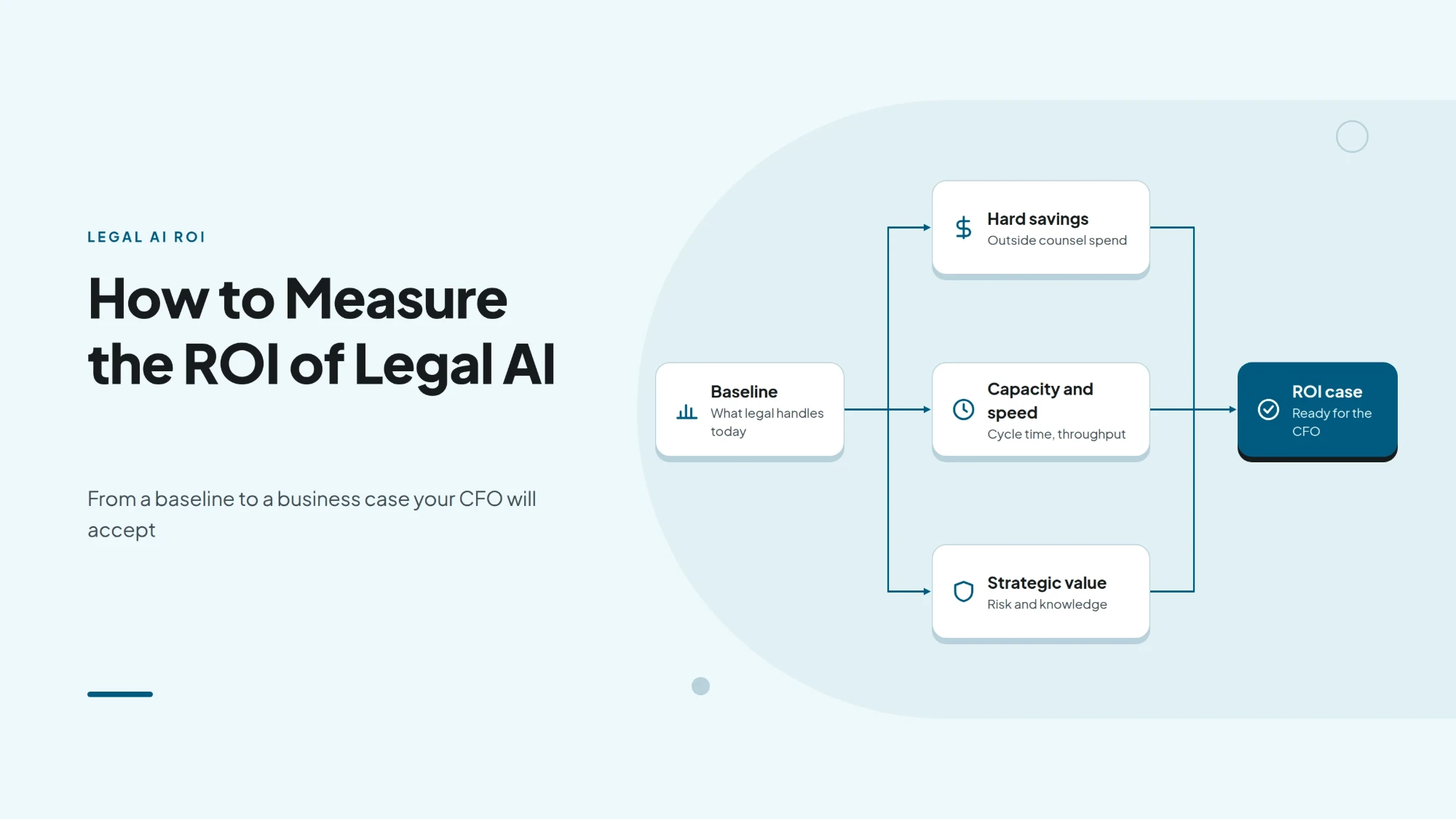
At a practical level, the most useful measures are demand, speed, deflection, quality and risk, and cost. The important point is not to treat them as five disconnected KPIs. They work together. Demand tells you what is arriving. Speed shows how it moves. Deflection shows how much capacity AI creates. Quality and risk tell you whether efficiency came at a cost. Cost shows the economics.
Why Is Legal AI ROI So Hard to Measure?
The problem is usually structural rather than analytical. A department cannot report a percentage improvement without a baseline, and a baseline requires knowing what the department handled before.
For many in-house teams, that information was never captured. Requests arrive through email, Slack, hallway conversations, forwarded threads, and meetings. Some get logged. Many do not. There is often no defensible answer to how many requests Legal received last quarter, what categories they fell into, which business units generated them, or how long they took to resolve.
Cost is different. Invoices exist whether or not anyone designed a measurement system. External spend can be pulled from finance, headcount from HR, and licence fees from procurement. Everything else has to be deliberately recorded at the point where work arrives.
Why You Need a Baseline Before Measuring Legal AI ROI
The practical sequence matters. A department that structures intake, runs it for a period of time, and only then introduces AI has a before-and-after comparison. A department that introduces AI first has an anecdote.
This is one reason legal AI programmes can end in an unresolved argument about whether they worked. The savings may be real. The evidence was never collected. Trying to reconstruct the baseline afterwards from invoices, spreadsheets, and memory rarely produces a comparison that finance or executive leadership can rely on.
A structured legal intake process changes that. Every request captured in a consistent structure becomes a data point. Over time, those data points create a record of demand, request types, response times, resolution patterns, and workload. That record becomes the baseline against which AI can be measured.
How to Build a Legal AI ROI Baseline
The baseline does not need to be complicated. Start by capturing legal requests consistently. The important fields are the request date and type, business unit, intake channel, assigned team or lawyer, response and resolution times, resolution method, whether lawyer involvement was required, outcome, rework or escalation, and relevant cost data.
Run that process long enough to establish a representative view of demand and performance. Then introduce AI and continue tracking the same measures.
Now the department has something it can compare. Before AI: what work arrived, how quickly did it move, who handled it, and what did it cost? After AI: what changed?
That is the foundation of a defensible legal AI ROI calculation.
A legal front door makes this baseline easier to create because capturing and structuring requests is part of the workflow itself. The data is not a separate reporting exercise. It is created as Legal does its work.
What Legal AI Metrics Should In-House Teams Track?
The first is demand. Legal teams need to understand how much work is arriving, what type of work it is, where it comes from, and how that demand changes over time. Demand is the denominator for many of the other measures, and it turns resourcing conversations from anecdote into evidence.
That matters in the current operating environment. CLOC's 2026 State of the Industry Report reports that demand is rising in areas including regulatory compliance and cybersecurity while budget and headcount growth expectations have flattened.
The second is speed. Intake-to-assignment time, first response time, and end-to-end turnaround show how quickly work moves through the department. First response time matters because it affects whether the business continues to route work through Legal at all. If the first response is slow, workaround behaviour becomes more likely.
The third is deflection. This is the share of inbound requests that can be resolved through self-service, automated routing, or documented positions without lawyer involvement. Deflection is where AI can create capacity rather than simply make existing work faster. But it is invisible unless requests are logged at the point of arrival.
The fourth is quality and risk. Efficiency only tells part of the story. Legal teams should also understand error and rework rates, escalation patterns, and what AI proposed versus what a lawyer changed.
Finally, there is cost. Cost belongs in the report, but it should sit alongside the other measures rather than stand in for them. Thomson Reuters makes the same broader point: efficiency gains matter, but the value they enable can include better advice, stronger risk protection, and faster business support.
Why Cost Savings Alone Is Not Enough
Cost savings are useful. They are also easy to explain. That is one reason they dominate legal AI reporting.
But when cost reduction becomes the only story a legal department tells, it can narrow how the function's value is understood. Thomson Reuters argues that when C-suite conversations focus only on how much Legal costs, the department risks being evaluated primarily through expense. The wider value that efficiency enables can then remain unmeasured.
AI ROI should therefore answer a broader question: is the legal department handling more work, at a better standard, for a defensible cost?
That can include faster business support, more work handled with existing resources, sharper risk identification, better service to internal stakeholders, higher-quality advice, and more capacity for work that requires legal judgment.
The Trap in Legal Department Volume Metrics
There is one important warning about demand data. Matter volume works well as a denominator and badly as a performance metric.
A department that gets better at self-service may handle fewer matters requiring lawyer involvement. A scorecard based on volume alone could read that improvement as decline.
The better approach is to report volume as context and improvement as the result. Requests received should be considered alongside the share resolved without lawyer involvement and the cycle time on the remaining work. Each number qualifies the others, producing a much clearer picture of what changed.
How to Report Legal AI ROI to the CFO
The final output does not need to be a complicated dashboard. One page can be enough: demand by category over time, the share of requests resolved without lawyer involvement, cycle time on the remaining work, error and escalation rates, cost per request, and internal and external spend.
Trend those measures over time and mark the AI implementation date on the timeline. The result answers a more useful question than "How much money did AI save?" It shows whether the legal department is handling more work, moving it faster, maintaining its standards, and doing so at a defensible cost.
That gives the CFO a view of AI's impact in the context of the function's actual work.
The Real Starting Point for Legal AI ROI
AI makes legal work easier to automate, accelerate, and scale. But measurement starts before the AI.
If requests are scattered across inboxes, chats, meetings, and forwarded threads, there is no reliable denominator. Without a denominator, there is no meaningful baseline. Without a baseline, proving what changed becomes difficult.
A structured legal front door creates that missing record. Every request becomes part of a consistent dataset. Over time, that dataset shows what Legal is handling, how it moves through the department, what can be resolved without lawyer involvement, and where AI is changing the equation.
The path to proving legal AI ROI starts with capturing the work.
ROI calculator. To model the potential impact for your own team, use Coheso's ROI Calculator to estimate time and capacity savings based on your organization's inputs.
See What This Could Look Like for Your Legal Team
Coheso brings legal intake, AI-powered self-service, work management, and analytics into one connected system. Book a demo to see how Coheso can help your team manage legal demand with greater visibility and less manual work.
Frequently Asked Questions About Legal AI ROI
How Do You Calculate ROI for Legal AI?
Compare the department's performance before and after AI across demand, cycle time, work resolved without lawyer involvement, quality and error rates, and cost. The comparison requires a baseline, which means requests need to be captured in a consistent structure before AI is introduced.
What Metrics Should Legal Teams Use to Measure AI ROI?
The core measures are demand, response and turnaround time, AI deflection or self-service resolution, quality and risk outcomes, and cost per request. Together, they show how AI affects both the economics and the performance of legal work.
Why Can't Most Legal Departments Measure AI ROI?
Because much of the underlying work was never recorded. Requests arrive through email, chat, meetings, and conversations, and many are never logged. Without a record of what Legal received and how long it took to handle, there is no reliable baseline for comparison.
How Do You Establish a Baseline for Legal AI?
Start by capturing legal requests consistently before introducing AI. Track the information needed to understand demand, speed, lawyer involvement, outcomes, and cost, then continue measuring the same things after AI is introduced.
Should Legal AI ROI Be Measured Through Cost Savings?
Cost savings should be part of the measurement, but not the only measure. AI can also create value through faster responses, increased self-service, reduced rework, better risk identification, and more capacity for work requiring legal judgment.
How Should Legal AI ROI Be Reported to the CFO?
A concise trend view can show demand, self-service resolution, cycle time, quality and risk measures, and cost over time. Mark the AI implementation date so changes can be evaluated against what the department was handling before implementation.