
Coheso Team
Coheso Team
How in-house legal teams can preserve institutional knowledge and turn past decisions into lasting guidance with Coheso Memory.
Legal teams spend years developing a working understanding of the business: which risks it will accept, where it draws the line, and when an exception makes sense. Some of that ends up in contract playbooks. The rest, from all the work outside contracts, rarely does. It lives in email threads, closed requests, and the heads of the attorneys who did the work.
That's fine until a similar question comes up again. Knowing that legal approved something isn't enough. You need to know what made it okay and whether that still holds. Without that context, you're left piecing the old decision back together or starting from scratch, whether it's a marketing review, a vendor approval, or a policy exception.
When "Legal Approved It" Is Only Half the Story
A customer agrees to let you feature their logo in a case study. Legal reviews the permission and approves it. Marketing publishes the story, and the request is closed.
Three months later, someone wants to put that logo on the homepage. There's already a legal approval on file, so reusing it seems reasonable.
But the permission only covered one case study, for six months. It never covered the homepage.
The original approval was right. The trouble is that its limits got lost along the way. Without those details, an old "yes" can support a decision the reviewer never meant to make.
You've probably seen versions of this before. An exception approved for a small pilot ends up applied to a full rollout. Advice based on an old policy keeps getting followed after the policy changes.
The conditions behind an approval are part of the answer. Lose them, and a one-time decision can quietly become a general rule.
The Quiet Cost of Lost Context
When the reasoning behind past decisions is hard to find, teams end up doing the same work twice. Business teams wait while legal rebuilds answers it has already reached, and those answers can start to drift apart.
It gets worse as teams grow or people move on. When an experienced attorney leaves, years of practical knowledge can go with them, even though every document is still on file. You keep the records but lose some of your ability to explain and build on your own decisions.
Why Legal Teams Need More Than a Searchable Archive
A searchable archive helps you find an old request. You still have to read the whole thread to figure out which facts mattered, why the team decided what it did, and whether the answer was meant to apply more widely.
Memory for legal teams means preserving that reasoning in a form people can use again. It's the part of legal knowledge management that most tools miss: making the team's institutional knowledge accessible beyond the person who handled the original question.
Useful memory puts that context up front. The next attorney can build on earlier work and focus on what's different this time. New team members can get up to speed on the team's positions without tracking down the one person who remembers. And when two requests get different answers, legal can explain which facts changed and why they matter.
That's what consistency really means. The outcomes don't always match, but everyone is working from the same understanding.
Extending Legal Playbooks Beyond Contracts
Coheso Memory helps in-house legal teams turn completed requests into a library of approved guidance, with the reasoning and context attached. Each entry sets out what to do, when it applies, and which exceptions matter, with links back to the original requests.
Because requests come in through Coheso's Legal Front Door, the work behind each decision is already captured in one place. Coheso Memory builds on that work, and an attorney reviews and approves the guidance before the team relies on it.
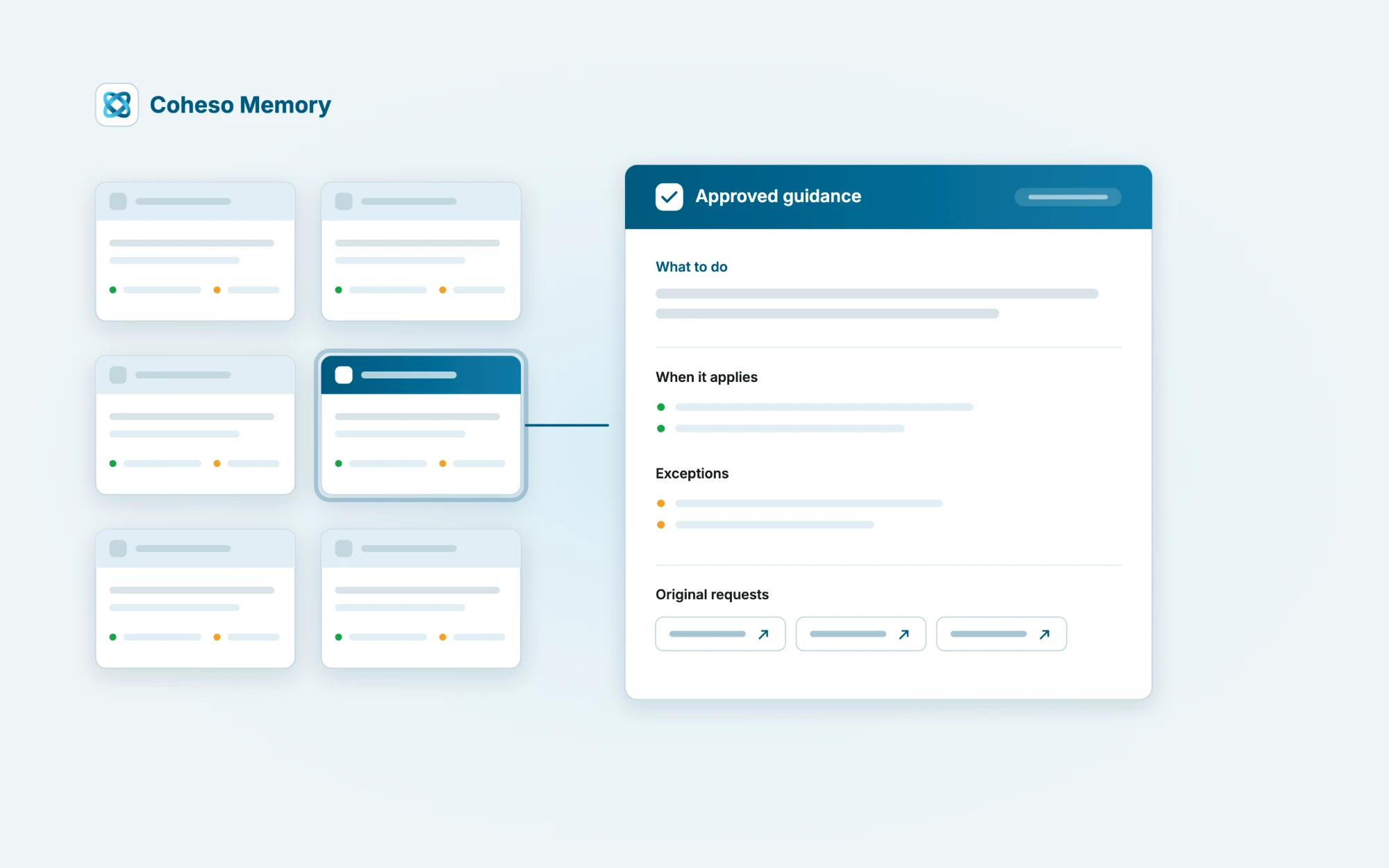
In the logo example, the guidance would preserve the scope of the permission and make clear that a use outside that scope needs its own review. The next reviewer sees that boundary instead of digging it out of an old conversation.
There's an important difference between a past decision and approved guidance. A decision records what the team concluded in one situation. Guidance is what the team agrees should shape future work. Keeping the reasoning and conditions attached helps maintain that distinction, and attorneys still decide when a question needs a fresh look.
Over time, patterns show up too. If the team keeps coming back to the same question, it may be time to update a policy or add to a playbook.
Keeping the Value of Work Already Done
A legal team's experience should grow more valuable over time. Each resolved question can make the next decision faster and better informed, as long as the knowledge stays within reach once the work is done.
Coheso Memory helps carry that experience forward, so the value of your team's work outlasts the original request and the person who handled it.
Contracts have playbooks. The rest of legal's work deserves a memory, too.
Book a demo to see how Coheso Memory turns past work into approved guidance.